and why no single technology has won the race. heroImage: /assets/blog/quantum-computing-race-technologies.jpg publishedAt: 2026-10-14 title: “The Quantum Computing Race Is Changing: Why the World Is seoTitle: “Quantum Computing Technologies Compared | OJANVU” Exploring More Than One Technology”
The Quantum Computing Race Is Changing: Why the World Is Exploring More Than One Technology
Quantum computing is moving through a period of rapid scientific and engineering development. Governments, universities, research laboratories, and technology companies are investing in different ways to build machines that use quantum physics to process information.
But there is no single blueprint for a quantum computer.
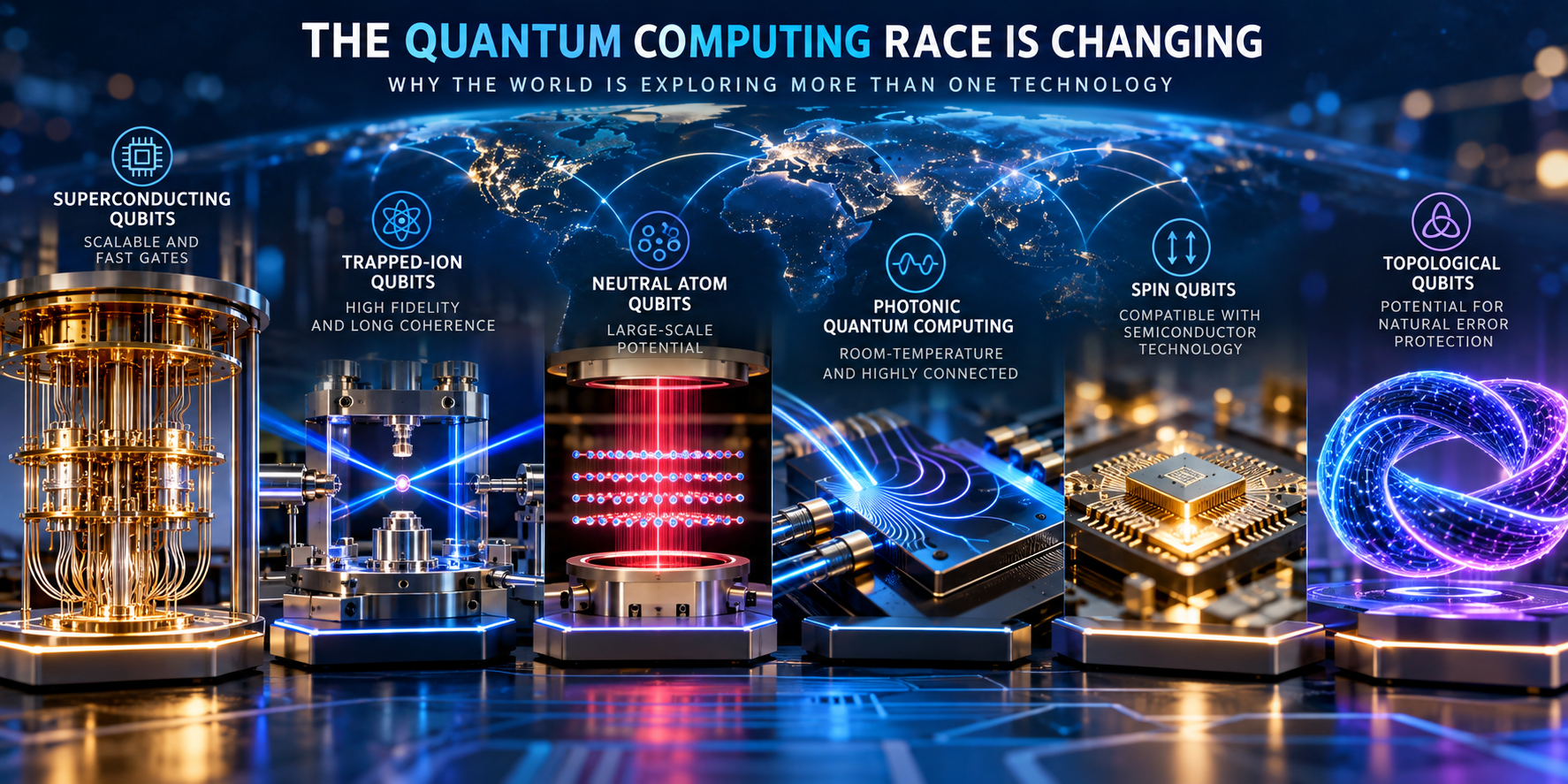
Some teams build processors from superconducting electrical circuits cooled to extremely low temperatures. Others control individual ions with lasers, arrange neutral atoms into programmable arrays, or investigate how photons-the particles of light-can carry and process quantum information. Researchers are also exploring semiconductor spin qubits and topological approaches.
This diversity is not a sign that quantum computing has lost direction. It reflects a central challenge: quantum information is powerful, but it is delicate, difficult to control, and challenging to scale. Different physical systems offer different combinations of speed, stability, connectivity, manufacturing potential, and engineering complexity.
As the field develops, the important question is no longer simply, “Which technology has the most qubits?” It is: Which architecture can reliably perform useful computations, at a scale and cost that make sense?
Why Are There Different Types of Quantum Computers?
A conventional computer represents information using bits, typically encoded as zeros and ones. Quantum computers use quantum bits, or qubits, which can be prepared in superpositions and entangled with other qubits.
The mathematics of quantum information is shared across platforms, but the physical hardware is not. A qubit can be encoded in an electrical circuit, an individual ion, a neutral atom, a semiconductor device, or a photonic system.
Each approach must solve several common problems:
- Control: How can quantum states be prepared and manipulated accurately?
- Noise: How can unwanted interactions with the environment be reduced?
- Readout: How can the result of a quantum computation be measured reliably?
- Connectivity: How can qubits interact with one another in the patterns an algorithm needs?
- Scaling: How can a larger system be built without making control and error correction unmanageable?
- Useful computation: Can the complete system solve a meaningful problem more effectively than available classical methods?
No single metric answers all of these questions. A processor with many physical qubits may still struggle with error rates, connectivity, or the overhead required to create reliable logical qubits.
1. Superconducting Qubits: Fast Operations on Tiny Circuits
Superconducting quantum computers encode quantum information in carefully engineered electrical circuits. These circuits behave like artificial atoms and are controlled using microwave signals.
The approach benefits from decades of progress in semiconductor-style fabrication, electronic control, and integrated-circuit engineering. Many superconducting systems can perform operations very quickly, making gate speed an important strength.
However, the circuits are highly sensitive to their environment. Most leading superconducting processors operate inside dilution refrigerators at temperatures close to absolute zero. Cooling, wiring, control electronics, calibration, and error correction all become major engineering considerations as systems grow.
Why it matters: Superconducting technology has a substantial experimental and software ecosystem, and it remains a major path toward larger quantum processors.
The challenge: Fast operations do not automatically produce long, reliable computations. Improving qubit quality and reducing the overhead of fault tolerance remain central goals.
2. Trapped Ions: Quantum Information Stored in Atoms
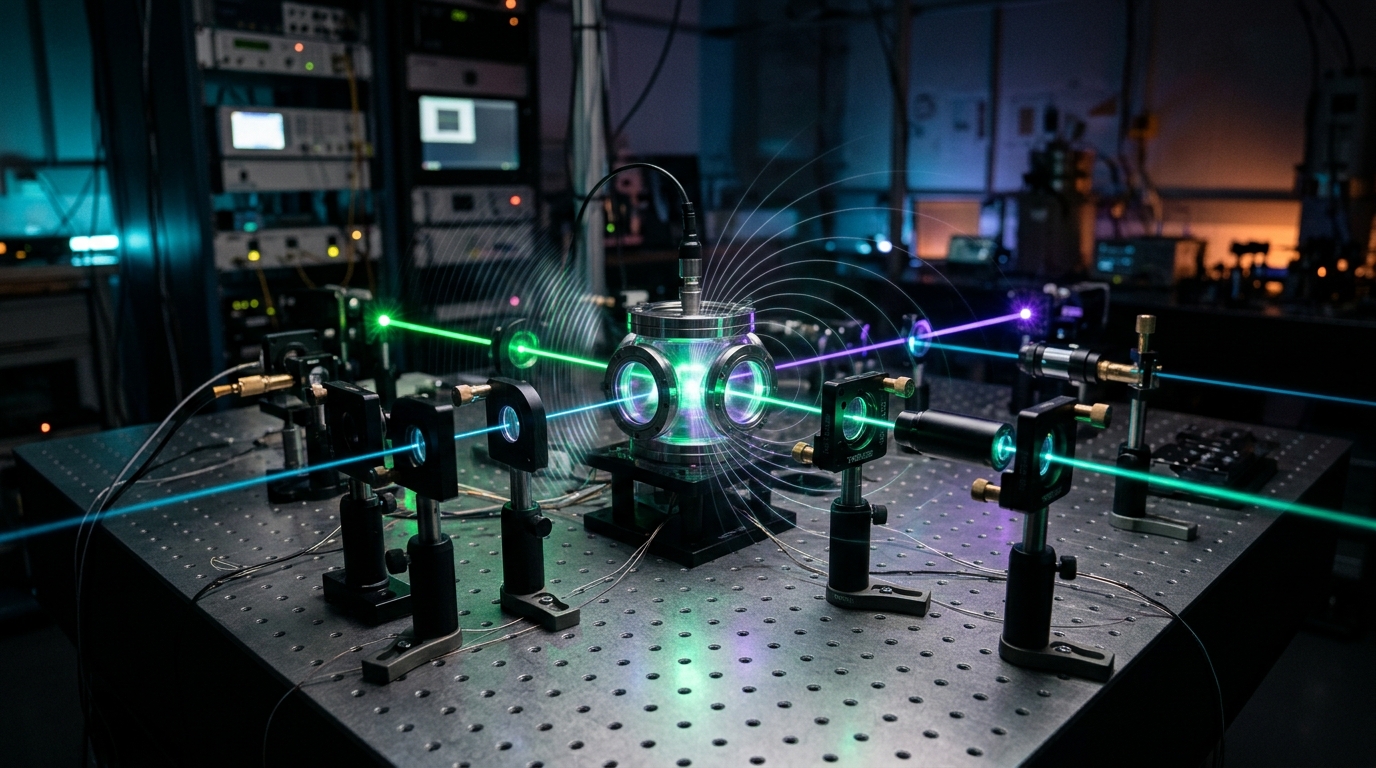
Trapped-ion computers use electrically charged atoms held in place by electromagnetic fields. Lasers or other carefully controlled optical systems manipulate the ions and help measure their quantum states.
Because ions are naturally identical quantum systems, trapped-ion platforms can offer long coherence times and high-quality operations. Their interactions can also support useful connectivity patterns.
The engineering challenges are different from those of superconducting circuits. Laser systems, vacuum equipment, ion transport, control complexity, and operation speed all matter. Scaling from a small, precise system to a much larger machine requires reliable ways to control and connect many ions.
Why it matters: Trapped ions demonstrate how atomic physics can provide a highly controlled foundation for quantum information processing.
The challenge: Preserving that control while increasing capacity and computational throughput is a major task.
3. Neutral Atoms: Building Programmable Arrays from Atoms
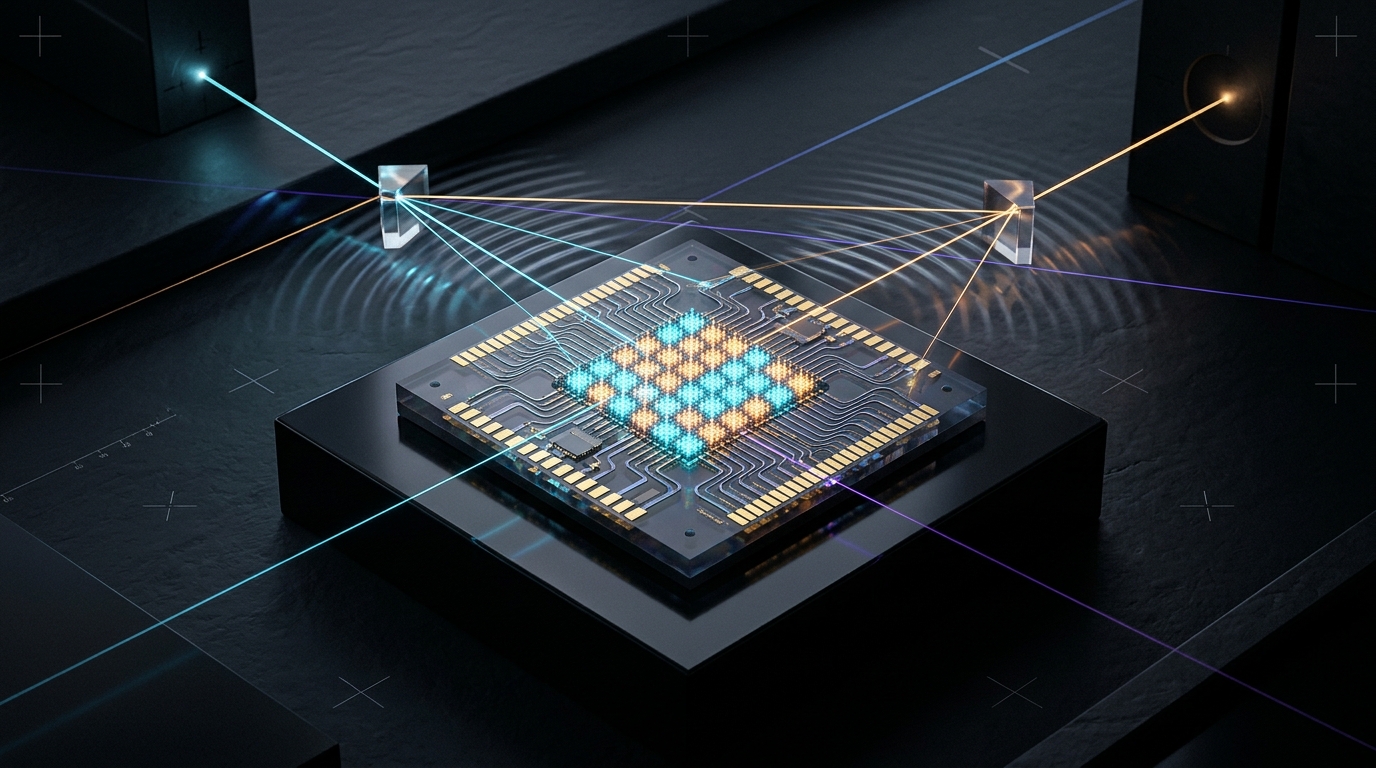
Neutral-atom quantum computers use individual atoms that have no net electric charge. Laser-based optical tweezers can arrange atoms into configurable arrays, while additional laser operations prepare, control, and measure their quantum states.
This architecture offers researchers a flexible way to create large, reconfigurable arrangements of qubits. The ability to change geometry can be valuable for exploring quantum simulations and different computational layouts.
Neutral atoms still require sophisticated experimental systems, including vacuum chambers, laser cooling, optical control, and methods for detecting and correcting errors. The number of atoms in an array is only one part of the picture: reliable operations and sustained computational performance matter just as much.
A notable sign of the field’s diversification came in March 2026, when Google Quantum AI announced that it was expanding its research to include neutral-atom quantum computing alongside its established superconducting work. The move illustrates that major research organizations are willing to explore multiple hardware paths rather than depend on only one. Read Google’s announcement.
Why it matters: Neutral atoms provide a different route to scalable, configurable quantum systems.
The challenge: Researchers must continue improving control, reliability, error correction, and the conversion of large arrays into useful computational resources.
4. Photonic Quantum Computing: Using Light to Carry Quantum Information
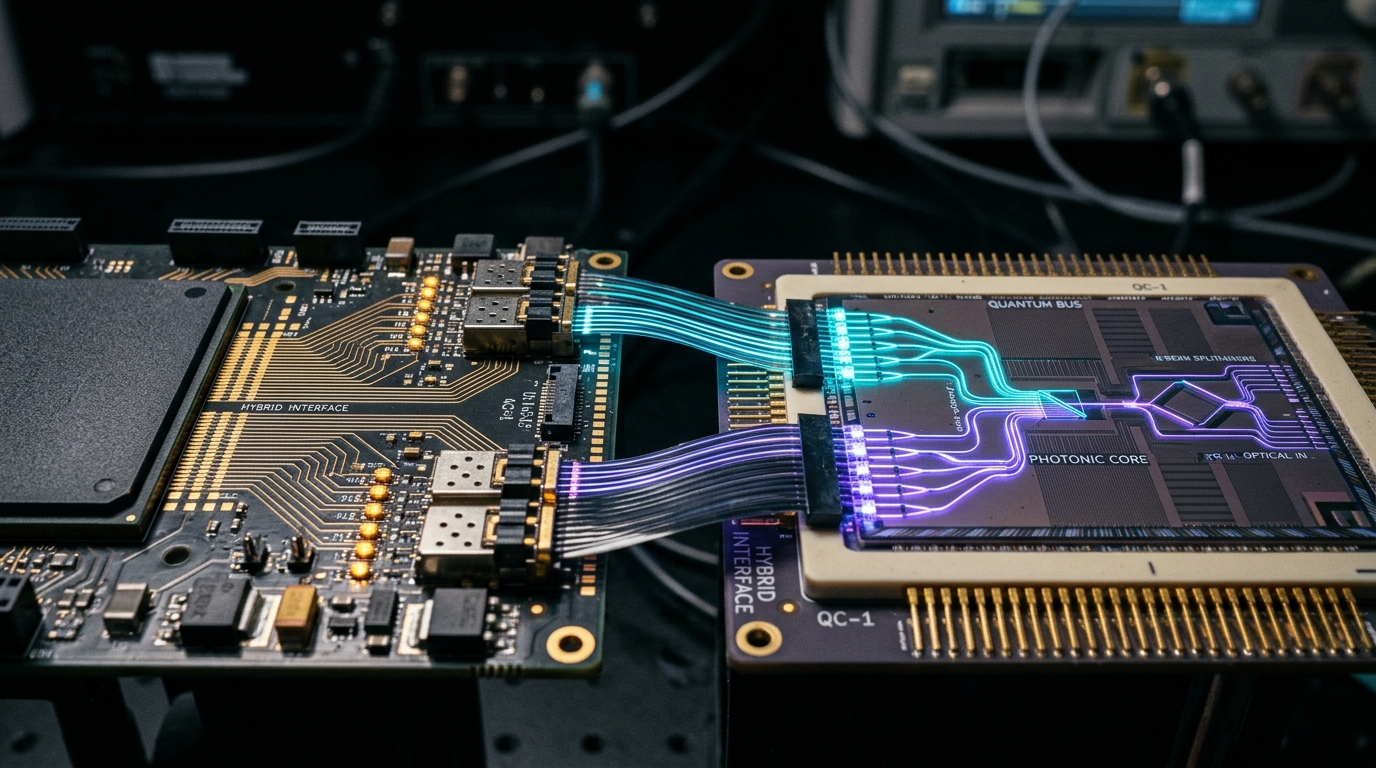
Photonic quantum computing uses particles of light-photons-to encode or transmit quantum information. Optical components such as waveguides, beam splitters, interferometers, detectors, and specialized light sources can be combined to implement quantum operations.
Photonics attracts interest for several reasons. Photons can travel through optical networks, and many photonic components can operate without the deep cryogenic environments required by superconducting qubits. Optical technology also connects naturally to established fields such as fiber-optic communications and integrated photonics.
However, photonic quantum computing is not automatically simple, loss-free, or entirely room-temperature. Photon loss can destroy quantum information, and reliable quantum operations require demanding control over light sources, interference, detection, and the architecture used for computation. Some components or approaches may still require cooling or other specialized operating conditions.
There are also different photonic approaches. Some use discrete-variable encodings, while others work with continuous-variable quantum states of light. These approaches have different physical requirements and computational designs; they should not be treated as interchangeable.
Why it matters: Photonics offers a distinct path for quantum information processing and networking, with potential benefits from optical integration.
The challenge: Reducing loss, implementing reliable operations, integrating components, and scaling error-corrected systems remain critical research problems.
For OJANVU Quantum Labs, photonic and continuous-variable approaches are particularly relevant areas to follow as part of this wider scientific landscape. The long-term significance of any architecture will depend on demonstrated performance, reproducibility, and its ability to support useful computations-not on the technology label alone.
5. Semiconductor Spin Qubits: Exploring Quantum Computing with Chip-Scale Devices
Semiconductor spin-qubit approaches encode quantum information in properties such as the spin of an electron confined in a semiconductor structure. These systems attract interest because they may be compatible with aspects of existing semiconductor manufacturing and miniaturization.
That potential does not mean quantum processors can simply be manufactured like ordinary computer chips today. Precise device fabrication, low-temperature operation in many implementations, control electronics, uniformity, and reliable interactions between qubits remain active research areas.
Why it matters: Semiconductor approaches could offer a path toward compact hardware and integration with established chip technologies.
The challenge: Researchers must demonstrate that device quality and control can remain consistent as systems grow.
6. Topological Qubits: A Different Strategy for Protecting Quantum Information
Topological quantum computing explores whether quantum information can be encoded in states that are intrinsically less sensitive to certain local disturbances. In principle, this could change the amount of error correction needed for reliable computation.
It is important to distinguish this goal from a mature, broadly demonstrated computing platform. Creating, verifying, and controlling the required physical states is difficult, and topological quantum computing remains a research-intensive approach.
Why it matters: If the necessary physical principles can be demonstrated and engineered, topological approaches could offer a different route to robust quantum information.
The challenge: Establishing convincing experimental evidence and building scalable, controllable systems are essential milestones.
Comparing the Main Quantum Computing Approaches
Technology What carries the Potential Major challenges qubit? strengths
Superconducting Engineered Fast operations; Cryogenic electrical chip-fabrication infrastructure, circuits ecosystem noise, wiring, error correction
Trapped ions Individual Long coherence; Laser and vacuum charged atoms precise control systems, operation speed, scaling
Neutral atoms Individual Reconfigurable Laser control, neutral atoms arrays; flexible atom loss, geometry reliable operations and error correction
Photonic Quantum states of Optical Photon loss, light networking; reliable potential for operations, room-temperature sources and components detectors, integration
Semiconductor Electron or Potential Device spin nuclear spin in chip-scale uniformity, semiconductor integration precise control, devices interactions and operating conditions
Topological Proposed Potentially Experimental protected quantum different validation and states error-protection scalable strategy implementation
This comparison is qualitative. Performance depends on the specific device, encoding, control system, error-correction strategy, and benchmark being measured. No platform should be declared the universal winner from qubit count or one laboratory result alone.
The Race Is Also About Error Correction
A quantum computer must do more than create qubits. It must keep information reliable long enough to execute a useful computation.
Physical qubits are the hardware elements built from circuits, atoms, photons, or other systems. Logical qubits are constructed from multiple physical resources and error-correction procedures to protect quantum information. The number of physical qubits required for a logical qubit depends on the architecture, noise, target error rate, and error-correction scheme.
This is why researchers increasingly focus on logical-qubit quality, error rates, the depth of reliable circuits, and the resources needed to run an algorithm. A system with fewer high-quality logical qubits may be more useful for a particular task than a system advertising a larger physical-qubit count.
The same principle applies to scaling. A convincing path to useful quantum computing must account for the full system: hardware, control, readout, classical computing, error correction, and the algorithm itself.
The Future May Be Hybrid—and Connected
The future of computing is not necessarily a contest in which one processor replaces every other kind of machine. Classical CPUs and GPUs are already essential to quantum experiments, and quantum processors may ultimately be used as specialized resources within larger computing workflows.
In March 2026, IBM published a quantum-centric supercomputing reference architecture describing how quantum processors could work alongside CPUs and GPUs in coordinated workflows. This is an example of the broader effort to integrate quantum computing with classical high-performance computing. Read IBM’s announcement.
Quantum networking is another area to watch. In October 2026, IonQ reported a milestone involving a photonic interconnect between a trapped-ion qubit and a solid-state quantum memory. Such research highlights how photons can play a role beyond photonic processors themselves: they may also help connect different quantum systems. Read IonQ’s announcement.
These developments do not mean that large-scale, fault-tolerant quantum computing has been solved. They show that the field is exploring both better individual processors and ways to connect quantum hardware with the broader computing environment.
What Does This Mean for the World?
Quantum computing is not expected to make every computer faster or replace conventional computing in everyday tasks. Its potential lies in specific problems where quantum algorithms may offer an advantage, including some simulations of molecules and materials, selected mathematical problems, and certain optimization or sampling tasks.
Whether a quantum system provides a practical advantage depends on the problem, the algorithm, the quality of the hardware, and the best available classical alternatives. Many proposed applications remain under investigation, and useful commercial impact will require more than promising demonstrations.
For the public, the most meaningful progress to follow includes:
- Reliable logical qubits and measurable improvements in error correction.
- Larger computations that can be independently verified.
- Clear comparisons with the best classical methods.
- Hardware systems that can operate consistently and be maintained.
- Evidence that a quantum approach solves a real problem with meaningful value.
These measures provide a more useful picture of progress than headlines focused on qubit counts alone.
Conclusion: Multiple Paths, One Scientific Challenge
The quantum computing race is changing because the field is learning that there is more than one way to build a quantum machine. Superconducting circuits, trapped ions, neutral atoms, photons, semiconductor spins, and topological research each represent different bets on how to control quantum information at scale.
The competition is not only about which architecture advances first. It is also about which combinations of hardware, error correction, software, networking, and classical computing can produce reliable and useful results.
For OJANVU Quantum Labs, following these developments means placing photonic and continuous-variable research within the broader global effort to make quantum computing practical. The field’s future will be shaped by careful experiments, transparent benchmarks, and continued progress across multiple approaches.
Quantum computing is not a single race toward one kind of machine. It is a global scientific effort to discover which technologies and which combinations of them can turn quantum physics into useful computing.