The future is not a competition between two types of computers
When people discuss quantum computing, a common question appears: Will quantum computers eventually replace classical computers?
It is an understandable question. Popular commentary often frames quantum hardware as the direct successor to classical silicon, implying that conventional computers will someday become obsolete relics. However, the reality of high-performance computing points in a fundamentally different direction: the future of computation is heterogeneous, collaborative, and hybrid.
Classical computers are exceptionally versatile. Decades of semiconductor manufacturing have optimized classical processors for deterministic branching, high-clock-rate sequential execution, complex memory indexing, database transactions, and everyday operating systems.
Quantum computers approach computation from a completely different physical regime. Rather than processing binary bits, they manipulate quantum mechanical amplitudes, phase-space distributions, and interference fringes to evaluate complex mathematical spaces that scale exponentially on classical silicon.
These strengths do not compete; they complement each other.
Rather than viewing quantum and classical hardware as rivals in a zero-sum race, computer scientists and hardware architects are designing integrated workflows where each architecture executes the subroutines it performs best.
What does hybrid quantum-classical computing mean?
Hybrid computing refers to an integrated software and hardware pipeline where classical processors (CPUs), parallel accelerators (GPUs), and specialized quantum processing units (QPUs) collaborate to solve a single problem.
In this architecture, the quantum processor functions as a dedicated domain-specific accelerator—analogous to how GPUs accelerate graphics rendering and tensor algebra, or how TPUs accelerate neural network training.
The division of computational labor in a hybrid pipeline is structured around physical strengths:
| Processing Unit | Core Architectural Strengths | Primary Role in Hybrid Pipeline |
|---|---|---|
| CPU (Central Processing Unit) | Low-latency serial execution, complex control flow, I/O orchestration | Orchestrates master job workflow, compiles circuits, manages memory bridges |
| GPU (Graphics Processing Unit) | Massive SIMD parallel arithmetic, tensor contractions, dense linear algebra | Pre-processes datasets, calculates classical gradients, simulates validation baselines |
| QPU (Quantum Processing Unit) | High-dimensional Hilbert space sampling, non-Gaussian transformations, entanglement | Executes computationally intractable kernel functions and complex Hamiltonian state evolutions |
The systems exchange data dynamically during runtime. A classical computer prepares input states and compiles algorithm parameters, the QPU executes the specialized quantum transformation, and classical hardware measures the resulting distributions to guide the next iteration.
The mechanics of hybrid workflows: An iterative feedback loop
To understand how hybrid computing operates in practice, consider Variational Quantum Algorithms (VQAs), such as the Variational Quantum Eigensolver (VQE) widely applied in computational chemistry and molecular simulation.
In a pure classical simulation, computing the ground-state energy of a complex molecule requires diagonalizing an intractable Hamiltonian matrix whose dimension doubles with each added electron orbital. On classical hardware alone, exact diagonalizations for molecules beyond modest sizes hit a combinatorial wall.
In a hybrid quantum-classical loop, the workload is distributed efficiently:
- Classical Parameter Initialization: A classical CPU constructs the molecular Hamiltonian and selects an initial set of mathematical parameters describing the molecular trial wavefunction.
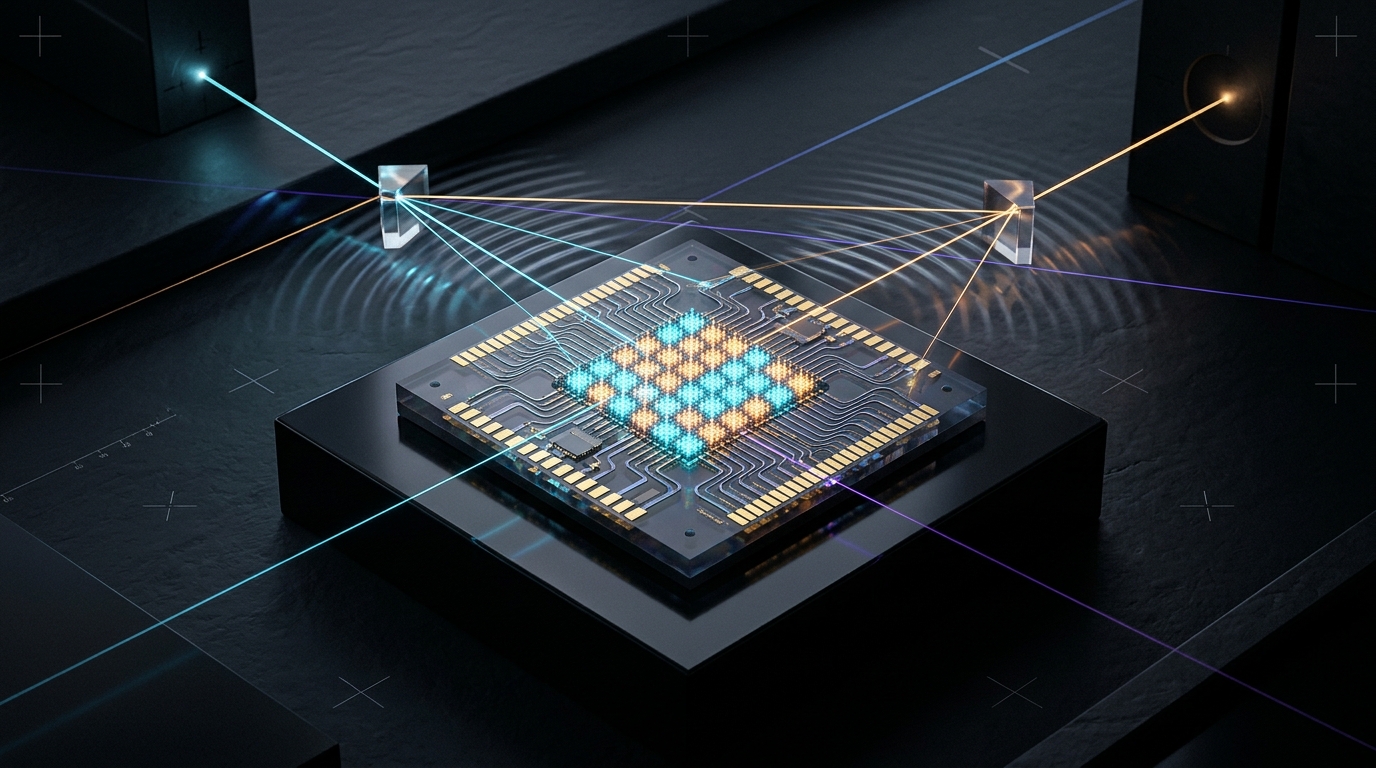
- Quantum State Preparation and Measurement: These parameters are transferred across a high-speed data bus to the quantum processor. The QPU prepares the corresponding optical or matter state, executes the quantum circuit, and measures the expected energy value.
- Classical Optimization Loop: The measurement results are fed back into a classical optimization algorithm running on classical processors. Classical optimizers (such as gradient descent or Nelder-Mead) evaluate the energy landscape and update the circuit parameters.
- Convergence: This loop repeats until the classical optimizer detects that the molecular ground-state energy has converged to its minimum.
By offloading only the exponentially hard quantum state preparation and expectation value measurement to the QPU, while delegating parameter optimization and error filtering to classical hardware, the hybrid system bypasses the scaling bottlenecks of both platforms.
Why classical computers will remain essential
Quantum processors do not automatically outperform classical computers across generic computing tasks. Many everyday computational workloads are already handled with peak efficiency by conventional hardware.
Furthermore, quantum computers cannot function in a vacuum. Operating a physical quantum processor requires extensive classical infrastructure:
- Signal Generation and Pulse Shaping: Every quantum gate requires high-precision classical arbitrary waveform generators and optical modulator drivers.
- Real-Time Control and Error Tracking: Quantum error detection and syndrome decoding require ultra-fast classical logic (often implemented on sub-nanosecond FPGAs or ASICs) to process error syndromes before quantum coherence degrades.
- Data Ingestion and Result Normalization: Modern scientific and financial applications ingest gigabytes to terabytes of raw structured data. Sorting, filtering, and preparing this data into quantum state amplitudes must be handled by high-throughput classical storage and memory fabrics.
Even when a quantum processor executes an extraordinarily powerful calculation, the surrounding workflow depends on classical computing from end to end. The complete system matters far more than an isolated chip milestone.
Hardware interconnects: Overcoming the latency bottleneck
For hybrid computing to reach commercial utility, communication between classical processors and quantum coprocessors must be fast and tightly integrated.
Historically, experimental quantum devices were operated as remote laboratory instruments connected via local network links or high-latency cloud APIs. While sufficient for exploratory research, cloud roundtrip latencies measured in hundreds of milliseconds make tight, iterative feedback loops like VQE prohibitively slow.
Modern high-performance computing centers are moving toward direct physical interconnects:
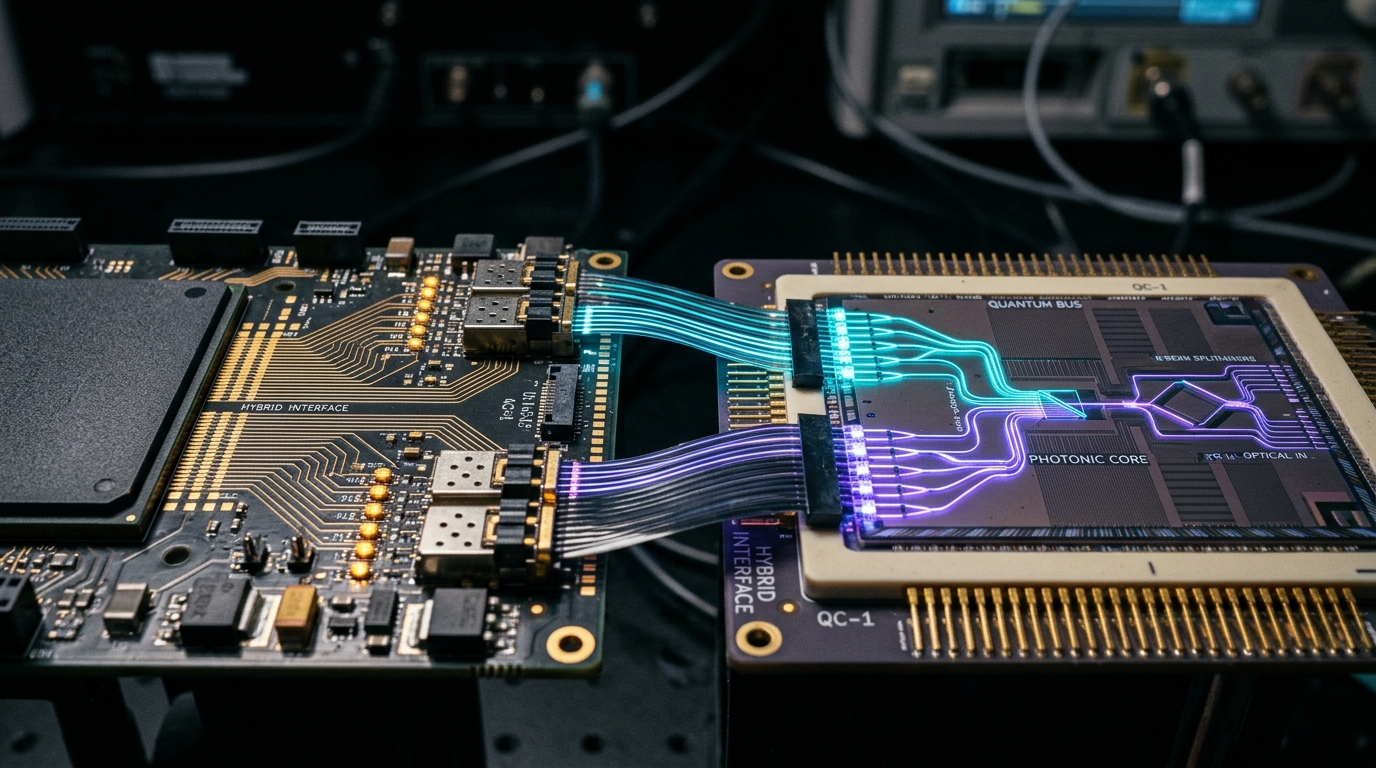
- PCIe Gen 5 and Gen 6 Integration: Interfacing QPUs directly to host server motherboards via high-throughput PCIe slots, providing transfer speeds exceeding 64 to 128 GB/s.
- Compute Express Link (CXL): Leveraging CXL cache-coherent protocols so host CPUs, GPUs, and quantum accelerators can share a unified virtual memory space without costly memory serialization overhead.
- Optical I/O Chiplets: Utilizing micro-optical transceivers that convert electrical signals to optical laser wavelengths at the chip package boundary, matching the native light-based medium of optical processors.
Direct bus-level integration changes the economic equation. Instead of treating quantum hardware as a distant, isolated mainframe, high-performance computing facilities can deploy quantum accelerators directly inside the same server chassis hosting classical cluster nodes.
The deployment advantage of room-temperature photonics
A primary barrier to enterprise hybrid computing has been the physical footprint of cryogenic dilution refrigerators. When a quantum processor requires cooling to 15 millikelvin using liquid helium, it cannot physically sit inside a conventional data center rack alongside high-density enterprise servers.
This physical divide is one of the principal reasons why room-temperature photonic quantum computing is gaining significant interest across the computing industry.
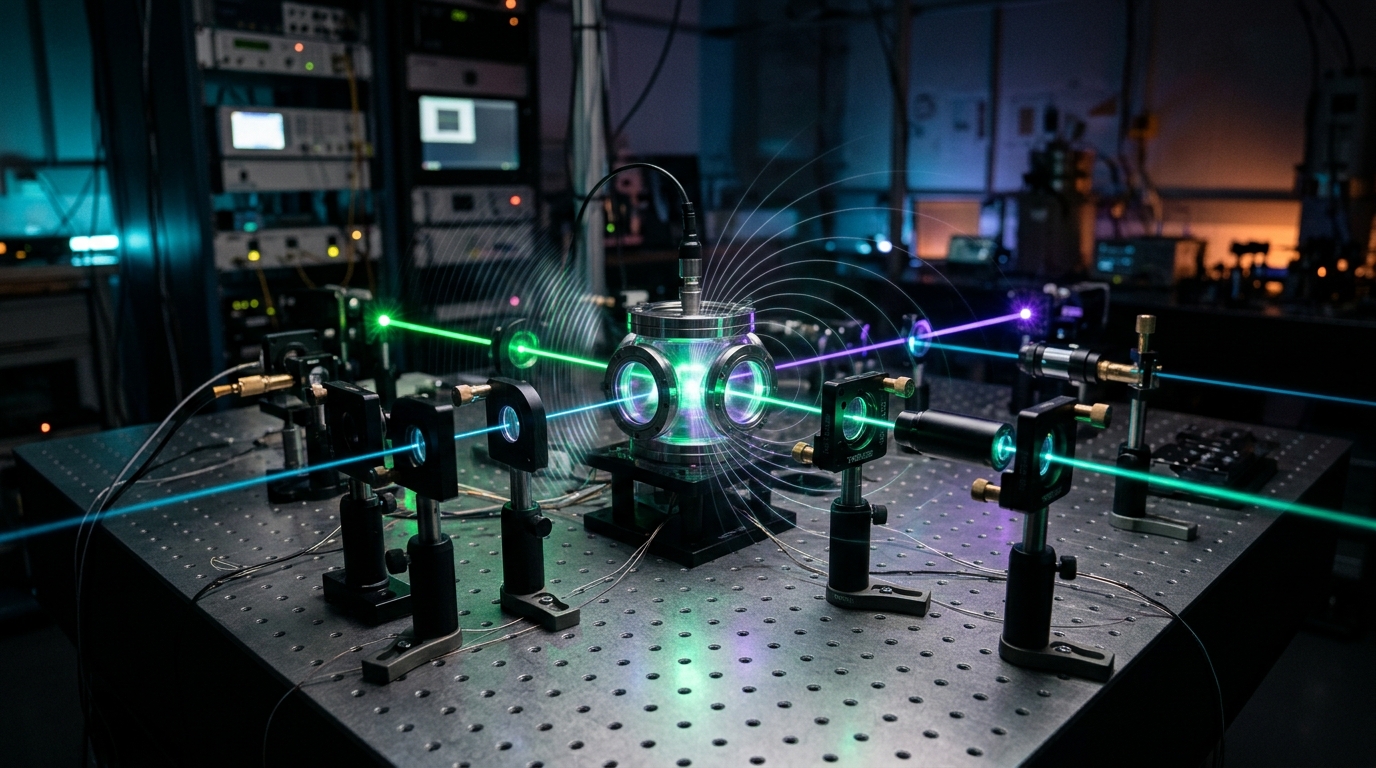
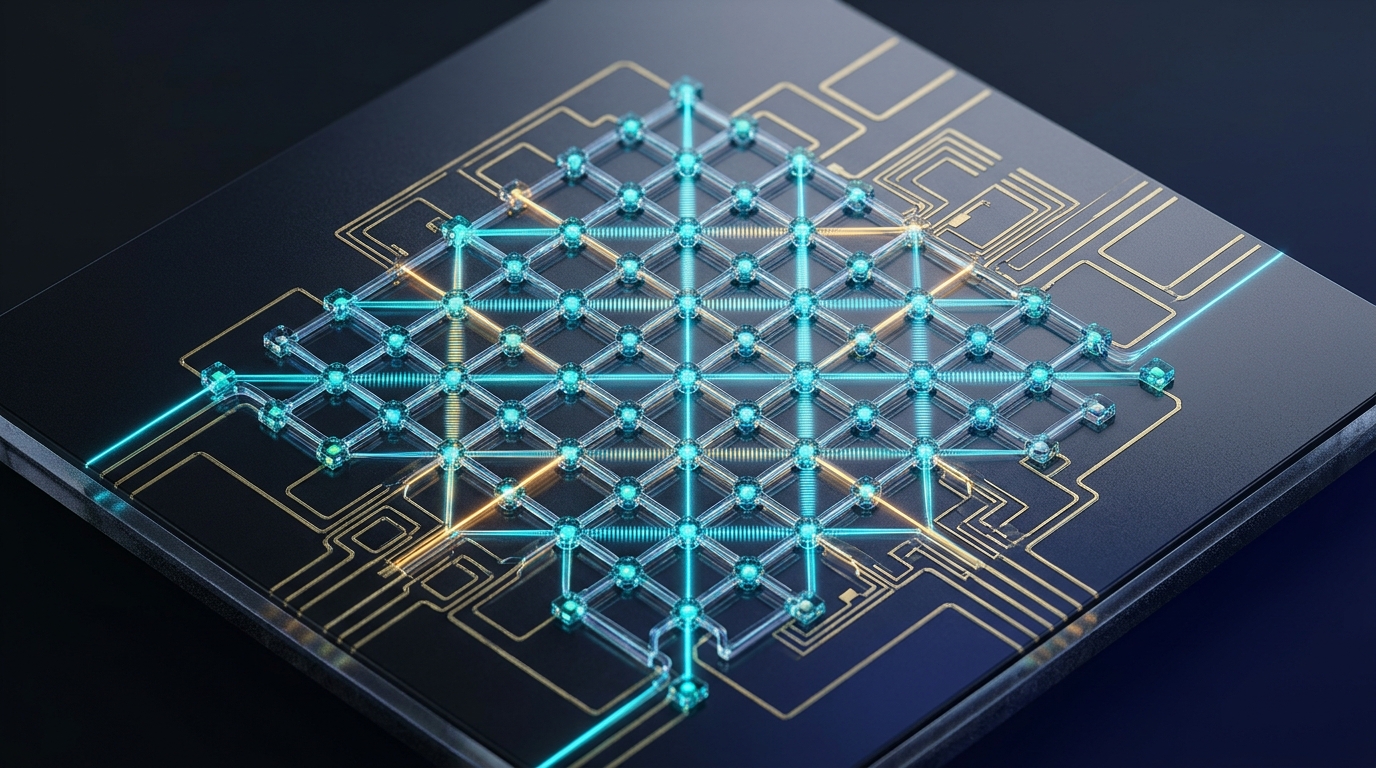
Because optical photons at telecom wavelengths (such as 1550 nanometers) possess single-photon energies significantly higher than ambient thermal noise at room temperature, optical waveguides and continuous-variable photonic processors do not require bulky cryogenic infrastructure.
By eliminating dilution refrigerators, photonic quantum co-processors can be packaged into standard 19-inch 2U or 4U rack-mounted enclosures. These units plug directly into existing 42U data center server racks, draw power from standard server power distribution units, and link directly to neighboring GPU clusters over PCIe and optical fiber.
This architectural compatibility removes the physical wall separating quantum acceleration from classical high-performance computing.
Key application areas for hybrid architectures
Researchers are actively demonstrating practical hybrid pipelines across several high-impact fields:
1. Molecular simulation and materials science
Designing pharmaceutical compounds, solid-state battery electrolytes, and high-temperature catalytic surfaces requires calculating complex electron correlations. Hybrid systems allow classical density functional theory (DFT) to model macroscopic bulk properties while a quantum accelerator computes strongly correlated active-site orbitals.
2. Combinatorial optimization and logistics
Global routing, dynamic supply chain reconfiguration, and telecommunication network scheduling involve discrete combinatorial spaces that quickly overwhelm classical solvers. Hybrid algorithms use classical heuristics to narrow the feasible solution space, then apply quantum sampling subroutines to escape local minima.
3. Quantitative finance and risk modeling
Evaluating complex derivative portfolios and multi-asset value-at-risk scenarios requires generating millions of stochastic paths. Photonic quantum circuits can accelerate Monte Carlo sampling distributions, with classical supercomputers managing historical data ingestion, risk metrics, and regulatory constraints.
4. Machine learning and generative models
Hybrid quantum neural networks combine deep learning tensor layers on GPUs with parameterized quantum circuit layers (PQCs). These hybrid networks are being studied for their ability to recognize intricate correlations in topological datasets that classical kernel methods struggle to classify.
A practical perspective on quantum progress
The advancement of quantum technology is not simply a contest to announce higher physical qubit numbers. A machine with numerous qubits is of limited value if it cannot be integrated reliably into operational software workflows.
Meaningful progress depends on algorithm efficiency, error mitigation, low-latency control electronics, and verifiable physical performance (as explored in our analysis of why the future of quantum computing depends on more than qubit count).
Different hardware platforms face distinct engineering constraints. The goal is not to force quantum hardware into problems that classical silicon already handles effortlessly. The true goal is identifying the high-value algorithmic bottlenecks where quantum mechanics provides a definitive computational advantage, and bridging that capability seamlessly into the classical supercomputing fabric.
The OJANVU Quantum Labs perspective
At OJANVU Quantum Labs, we engineer room-temperature photonic quantum computing systems built specifically for native data center integration.
We believe the future of computing will not be defined by a single monolithic architecture. The computational demands of the coming decades—from climate modeling and energy storage to autonomous systems and molecular biology—require the combined power of CPUs, GPUs, and quantum accelerators working as a unified team.
Quantum processors will achieve their greatest impact not by replacing the digital computing world, but by elevating it.
The future is not quantum versus classical. It is choosing the right computational tool for the right problem.